Have you wondered why unsecured loans are rarely available at decent rates? It is because people who apply for unsecured loans likely don’t want to utilize real estate or other assets as collateral. Moreover, since these borrowers of unsecured loans do not offer a guarantee for repayment, this further complicates the loaning procedure. Let’s see the best unsecured loans of September 2026.
It is tough for lenders to put trust in borrowers based on their credit score and promise alone. But some still offer affordable unsecured loans and provide financing as high as $100,000 with APRs ranging from 2.49% to 35.99%, depending on various factors.
Bad credit scores are a big turnoff for most lenders. However, some offer high loans and flexible terms to browsers even with low credit scores. Taking a loan can be critical, especially if you do not want to place upfront collateral. Our marketplace eases this exhausting process in a matter of a few clicks. You can keep up-to-date on available options before you commit to an unsecured loan.
Let us now look at the best-unsecured loan options available of September 2026 and all the information you need to make the right choice.

Why Trust Us?
Our marketplace provides a one-stop solution to help you find the best lenders inclined to give you the best terms among the dozens available and reviewed by borrowers. We reach out and research the best lenders to provide you with only the most credible information, making no compromise on your finances.
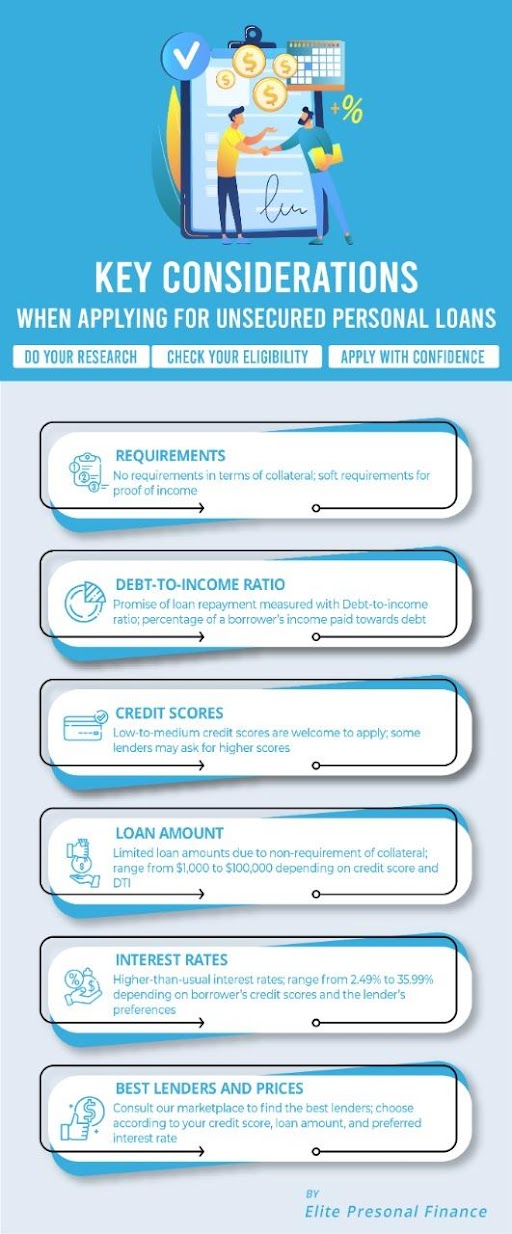
Best Unsecured Loans of September 2026: Key Findings
Requirements
Unsecured loans have little to no requirements in terms of income and collateral. While lenders do not require collateral, some require proof of income before giving a loan.
Debt-to-Income Ratio
Debt-to-income ratio (DTI) is a percentage of a borrower’s income paid towards debt. Some lenders use this to predict a borrower’s promise towards loan repayment.
Credit Score
Loan lenders have varying credit score requirements, with some not imposing any. A high credit score often means access to larger loan amounts and vice versa.
Loan Amount
As unsecured loans do not require any collateral, the loan amounts are limited and depend on the borrower’s credit score and return a promise. Some lenders offer loan amounts as high as $100,000.
Interest Rates
Unsecured loans are often followed by high-interest rates, which differ from the borrower’s credit score. Unsecured loan Lenders have an APR range of 2.49% to 35.99%, which varies depending on the lender and other related factors.
Best Lenders and Prices
When finding the best prices, it is best to consider all variables and do thorough research before making your choice. Consider consulting our marketplace to find the best lenders according to your credit score, loan amount, and preferred interest rates.
Best Unsecured Loans of September 2026
The following is a compilation of the best unsecured loan providers to help you.
| Lender: | Types of Loans: | Amount: | APR: | Min. Credit Score: | DTI: | Best For: | Apply: |
|---|---|---|---|---|---|---|---|
Avant![]() |
Debt Consolidation Loan Unsecured Personal Loan Term Loan | $2,000 – $35,000 | 9.95% – 35.99% | 580 | <70% | Annual income as low as $20,000 | Apply Now SSL No Credit Effect |
Prosper![]() |

Unsecured Personal Loan Debt Consolidation Loan | $2,000 – $40,000 | 7.95% – 35.99% | 640 | <50% | Obtaining multiple unsecured personal loans | Apply Now SSL No Credit Effect |
Figure![]() |
Unsecured personal loans | $5,000 – $50,000 | 5.75% – 22.94% | 620 | <50% | Higher loan amounts | Apply Now SSL No Credit Effect |
Upgrade![]() |

Unsecured personal loans Credit consolidation loans | $1,000 – $50,000 | 7.99% to 35.99% | 580 | <75% | No prepayment fees on an unsecured loan | Apply Now SSL No Credit Effect |
Upstart![]() |

Unsecured Personal Loans Debt and Credit Consolidation Loans | $1,000 – $75,000 | 6.6% – 35.99% | 300 | <50% | Low credit score limit for unsecured loans | Apply Now SSL No Credit Effect |
TD Bank![]() |

Unsecured personal installment loans | $2,000 – $50,000 | 6.99% – 18.99% | 700 | <43% | No origination, prepayment, application, or insufficient funds fees. | Apply Now SSL No Credit Effect |
Wells Fargo![]() |

Unsecured personal loan | $3,000 – $100,000 | 5.74% – 19.99% | 660 | <43% | Wells Fargo customers | Apply Now SSL No Credit Effect |
LightStream![]() |

Debt Consolidation Unsecured Personal Loans | $5,000 – $100,000 | 2.49% – 19.99% | 660 | <45% | Large unsecured personal loans | Apply Now SSL No Credit Effect |
Navy Federal Credit Union![]() |

Debt Consolidation Unsecured Personal Loan | $250 – $50,000 | Earnings rate plus 2%; 7.49% – 18.00% | Unlisted | <43% | Service members and affiliates. | Apply Now SSL No Credit Effect |
SoFi![]() |

Unsecured Personal Loans Unsecured Student Loans Credit Consolidation Loan | $5,000 – $100,000 | 5.74% – 20.28% | 680 | <45% | No-fee unsecured loans | Apply Now SSL No Credit Effect |
LendingTree![]() |

Unsecured Personal Loans Credit Consolidation Loans | $1,000 – $50,000 | 2.49% – 35.99% | 600 | <43% | Low APR on unsecured loans | Apply Now SSL No Credit Effect |
PersonalLoans![]() |

Unsecured Personal Loans | $1,000 – $35,000 | 5.99% – 35.99% | 580 | <43% | Short and long-term personal loans | Apply Now SSL No Credit Effect |
PenFed![]() |

Unsecured union personal loans | $600 – $50,000 | 7.74% – 17.99% | Undisclosed | <50% | Unsecured personal loans from unions | Apply Now SSL No Credit Effect |
PNC Bank![]() |
Unsecured personal loans | $1,000 – $35,000 | 5.99% – 35.99% | 660 | <55% | Online and in-person service | Apply Now SSL No Credit Effect |
OneMain Financial![]() |
Unsecured personal loans | $1,500 – $20,000 | 18% – 35.99% | 600 – 650 | <35.99% | Low credit limit on unsecured personal loans | Apply Now SSL No Credit Effect |
Avant
Fees:
- Administration fee of up to 9.99% of the loan amount
- Administration fee is deducted from the loan proceeds
- Administration fee is treated as part of the loan principal and accrues interest
- No application fee
- No prepayment penalty
- Late payment fees may apply according to the applicable state and loan agreement
- Returned or dishonored payment fees may apply according to the applicable state and loan agreement
- Actual fees may vary based on state law and the loan agreement
Qualification Criteria:
- Minimum age: 18
- Must have a valid personal checking or savings account
- Must provide verifiable personal and financial information
- Credit score, credit history, income, and employment stability may be considered
- Outstanding debt and ability to repay may be considered
- A credit score as low as 550 may qualify
- Avant customers typically have credit scores between 550 and 700
- Checking your loan options does not impact your credit score
- Additional documentation may be requested during the application process
- Loan eligibility, minimum loan amount, APR, and terms may vary by state
- Not all applicants will qualify
Average Borrower Profile:
- Avant customers who take out personal loans typically have credit scores between 550 and 700
- Borrowers with credit scores as low as 550 may qualify
- Income, employment stability, outstanding debt, and credit history may affect eligibility
- Actual loan amount, APR, fees, and repayment terms depend on the applicant's qualifications and state
Best For
- $20,000 annual incomes
Avant offers an unsecured personal loan of amounts upto $35,000 and APR upto 35.99%, requiring a minimum credit score of only 580. Its flexible terms of upto 5 years and transparent fees make it a trustable option for an unsecured loan with low credit scores.
Though Avant doesn’t have any membership requirements, it requires the borrower to be above 18 years of age to obtain an unsecured personal loan. Some fees are associated with Avant’s unsecured loans, such as the administrative fees of up to 4.75% of the total loan amount.
Avant has the loan delivered to the borrower within one business day, making it an ideal unsecured loan option for urgent matters. Despite somewhat high fee rates, Avant offers flexible terms, credit score, monthly surplus, and DTI ratio criteria, making it a great option for your unsecured loan.
Pros:
Pros of Avant are that it:
- Offers unsecured personal loans of up to $35,000.
- Has flexible repayment terms of up to 5 years.
- Gives loans to borrowers with a credit score as low as 580.
- Does not impact your credit score to apply for a loan.
- Has lenient underwriting.
- Has no fees associated with early payoff.
- Requires no hard credit checks for pre-qualification
- Has fast loan lending, ideally within a day
Cons:
Cons of Avant are that it:
- Has a high APR range of up to 35.95%.
- Has high fees; loan origination fee is up to 4.75%, late payment fee of up to $25 after a 10-day grace period, and insufficient funds fee of $15.
- Requires income documentation.
- Has a low amount of loan, up to $35,000.
The impact of COVID-19
Avant’s unsecured loans support borrowers through the aftermath of Covid-19. It offers support programs to borrowers, such as schedule delays and extensions. Avant also has an online dashboard and app for borrowers to schedule payments, contact lenders, and keep up to date with their transactions, balances, and available credit.
Prosper
Fees:
- Origination fee of 1% – 9.99% of the loan amount
- Origination fee is deducted from the loan proceeds before funds are transferred
- Check payment processing fee of 5% of the payment amount or $5, whichever is less
- Late payment fee of $15 or 5% of the unpaid monthly payment, whichever is greater, after 15 calendar days
- Insufficient funds fee of $15 for each returned or failed payment
- No prepayment penalty
- No upfront fee to apply; the origination fee is charged only if the loan is funded
Qualification Criteria:
- Minimum age: 18
- Must be a U.S. resident
- Must reside in a state where Prosper loans are available
- Must have a U.S. bank account
- Must have a valid Social Security number
- Minimum credit score of 640
- Must meet Prosper and WebBank's underwriting requirements
- Credit history and financial history are considered
- Monthly income and monthly expenses are considered
- Ability to repay the loan is evaluated
- Prosper may consider the applicant's debt obligations and overall financial profile
- Identity verification is required
- Applicants may be asked to provide a driver's license or other identifying documents
- Joint applications with a co-applicant are available
- Checking your rate does not affect your credit score
- Not all applicants will qualify
- Loan approval also requires sufficient funding commitments
Average Borrower Profile:
- Average Prosper loan size was $16,274 for May 2026 originations
- Weighted-average borrower rate was 15.9% for May 2026 originations
- Average borrower credit score was 708 for May 2026 originations
- Median monthly payment-to-income ratio was 5.1% for May 2026 originations
- The average APR for 3-year loans funded from January 1 through March 31, 2026, was 24.19%
- Actual loan amount, APR, fees, and repayment terms depend on the applicant's qualifications
Best For
- Obtaining multiple personal loans
Prosper, with its unsecured loans ranging from $2,000 to $40,000, also provides the ability to take multiple loans simultaneously. An APR range of 7.95% to 35.99% and an extensive return term make it a viable option. Additional loans have regulations such as good standing and a strict balance limit of $40,000.
A late payment fee is applied 15 days after the due date, which is 5% or $15 depending on which is larger. Prosper offers terms ranging from three to five years and has a DTI ratio of no larger than 50%. Though Prosper has a loan origination fee of 2.41% to 5%, no prepayment is required on your unsecured loan.
Pros
Pros of Prosper are that it:
- Has a flexible loan range of $2,000 to $40,000.
- Allows borrowers to take multiple loans at a time.
- Has an APR range of 7.95% to 35.99%.
- Accepts a low credit score of 640.
- Has extensive terms of 3 – 5 years.
- Requires no prepayment and also offers pre-approval.
- Offers a 15-day grace period.
- Does not affect your credit score to take a loan.
Cons
Cons of Prosper are that it:
- Has late payment fees and loan origination fees.
- Does not consider alternative credit data.
- Requires a positive annual income and supports strict bankruptcy and credit profile inquiry regulations.
The impact of COVID-19
Prosper offers leverage to borrowers during the pandemic and its aftermath. Prosper assists borrowers suffering from financial hardships with its extensive terms and 15-day grace period. Further support is available on the company’s online portal and help center.
Figure
Fees
- Origination fee of 0% – 4.99% of the initial draw may apply
- No account opening fees
- No maintenance fees
- No prepayment penalties
- Valuation, appraisal, notarization, recording, and recording-tax costs may apply in certain situations
- Property insurance is required
- Actual APR depends on credit profile, combined loan-to-value ratio, loan term, property occupancy, state, and other factors
- Figure offers both fixed-rate and variable-rate HELOC options
Qualification Criteria
- Minimum age: 18
- Must own a qualifying property
- Minimum credit score of 600 in most states
- Minimum credit score of 660+ for investment properties
- Must have sufficient home equity
- Must have a reliable payment history
- Must have a manageable debt-to-income ratio
- Must provide verifiable income and property information
- Loan availability and requirements vary by state and property type
- Not all applicants will qualify
Average Borrower Profile
- Figure does not publish a current average HELOC borrower profile on its consumer site
- Figure's 2025 company filing reports an average customer credit score of approximately 748 for Figure-branded HELOCs
- Credit score, debt-to-income ratio, property value, lien position, income, and available equity affect eligibility
- Actual loan amount, APR, fees, and repayment terms depend on the applicant's qualifications
Best For
- Secured Loan for Debt Consolidation
Figure provides an unsecured loan ranging from $5,000 to $50,000. The APR for a secured loan is around 3.99% to 11.5%, which is lower than the unsecured loan APR of 5.75% to 22.94%. A loan origination fee, recording fee, and subordinating fee may be applicable depending on the conditions of your unsecured loan.
Pros
Pros of Figure are that it:
- Has a low unsecured loan APR of 5.75%.
- Has a fast loan approval and distribution process; ideally, approval is within a day.
- Offers flexible loan terms.
Cons
Cons of Figure are that it:
- Has origination fees, autopay, subordination fees, and recording fees associated with the loan.
- Has an extensive funding process taking 5 days or longer.
- Offers unsecured loans to borrowers from a limited number of states
- Associates a low credit score with higher APR and lower loan amounts.
The Impact of COVID -19
While Figure has a blog to raise awareness about financial well-being during the pandemic, no official support or leverage is listed for the borrowers. You can contact the support center for further details regarding their policies.

Upgrade
Fees
- Origination fee of 1.85% – 9.99% of the loan amount
- Origination fee is deducted from the loan proceeds
- Late payment fee of up to $10 if the full payment is not received within 15 calendar days of the due date
- Failed electronic or check payment fee of $10 per occurrence
- One-time title transfer fee may apply to certain secured loans; amount is determined by the local motor vehicle agency
- No application fee
- No prepayment penalty
Qualification Criteria
- Minimum age: 18, or 19 in Alabama and certain other states
- Must be a U.S. citizen, permanent resident, or living in the U.S. on a valid visa
- Must provide a verifiable bank account
- Must provide a valid email address
- Credit score, credit usage, and credit history are considered
- Income and employment information are considered during the final review
- Debt-to-income ratio and existing debt obligations may be considered
- May be required to provide proof of income, identity, employment, or other documentation
- W-2 employees may provide gross income; self-employed applicants may provide net income
- Checking your rate uses a soft credit inquiry and does not affect your credit score
- A hard credit inquiry occurs after the loan is funded
- Certain secured loan offers may require collateral
- Loan amounts and terms may vary by state
- Not all applicants will qualify
Average Borrower Profile
- Upgrade does not currently publish a verified average funded personal-loan amount or average borrower credit score
- Loan offers depend on credit score, credit usage history, income, requested loan amount, and other financial information
- Upgrade's current personal-loan product is designed for borrowers across a range of credit profiles
- Actual loan amount, APR, fees, and repayment terms depend on the applicant's qualifications
Best For
- High DTI ratios
Upgrade offers unsecured loans as high as $50,000 with flexible terms of two to seven years. It has a minimum credit score limit of only 580. The loan origination fee ranges from 1.85% to 9.99%. Failure to pay loan payments on time can result in a fee of $10.
Upgrade has a high DTI ratio, requiring borrowers not to exceed 75%. It has no prepayment fees, but the aforementioned late fee and an insufficient funds fee of $10 apply. The late fee has a 15-day grace period. Upgrade’s unsecured loans are also not available in some states.
Pros
Pros of Upgrade are that it:
- Provides an unsecured loan of $1,000 to $50,000.
- Low APR.
- Offers a 15-day grace period before applying a late payment fee.
- Has flexible repayment terms.
- Offers high DTI rates and has a low minimum credit score requirement.
- Does not impact your credit score to apply for a loan.
Cons
Cons of Upgrade are that it:
- Has a loan origination fee, insufficient funds fee, and late payment fee.
- Does not offer unsecured loans in every state.
The impact of COVID-19
Assistance is provided to financially struggling borrowers during the pandemic. A grace period is also offered before late payment fees are applied. For further assistance, you directly contact or email the Upgrade support center.
Upgrade Disclaimer:
Personal loans made through Upgrade feature Annual Percentage Rates (APRs) of 7.74%-35.99% and a 1.85%-9.99% origination fee, which is deducted from the loan proceeds. Lowest rates require Autopay and paying off a portion of existing debt directly. For certain discounts, collateral may be required. Repayment terms from 24 to 84 months. For example, if you receive a $10,000 unsecured loan with a 36-month term and a 17.59% APR (which includes a 13.94% yearly interest rate and a 5% one-time origination fee), you would receive $9,500 and would have a required monthly payment of $341.48. Over the life of the loan, your payments would total $12,293.46. The APR and other terms of your loan may vary and you may not be presented with multiple offers. If offered, your loan terms, including your rate, will depend on credit score, credit usage history, loan amount, and other factors. Late payments or other fees, as noted in your Borrower Agreement, may increase the cost of your fixed rate loan. Certain loan offers may not be available in all states.
After acceptance, your funds will be sent within one (1) business day of clearing necessary verifications. Funds availability is dependent upon your bank’s transaction processing time and may take up to 2 weeks if sent directly to third party creditors.
App Store® is a registered trademark of Apple Inc. Google Play™ and the Google Play logo are trademarks of Google LLC. ©2017-2026™, NerdWallet, Inc. All Rights Reserved. ©1995-2026 The Motley Fool. “The Ascent” is owned by the Motley Fool.

Upstart
Fees
- Origination fee of 0% – 12% of the loan amount
- Late payment fee of 5% of the past-due amount or $15, whichever is greater, if payment is more than 10 calendar days late
- ACH return fee of $15 per occurrence
- Returned check fee of $15 per occurrence
- Paper copies fee of $10 if eSign consent is withdrawn and paper records are requested
- No prepayment penalty
- Exact fees are disclosed in the loan agreement and may vary by creditor, loan terms, and state
Qualification Criteria
- Minimum age: 18
- Must be a U.S. resident
- Minimum annual income of $12,000 is required to apply
- Must provide valid personal and financial information
- Must have sufficient income and ability to repay the loan
- Credit history and credit profile are considered
- Debt-to-income ratio and existing debt obligations may be considered
- Employment history and income stability may be considered
- Upstart may consider W-2, self-employment, gig, freelance, retirement, disability, Social Security, pension, and other eligible income
- Upstart's model considers income, employment, education, and other factors beyond credit history
- No minimum educational attainment is required
- Checking your rate uses a soft credit inquiry and does not affect your credit score
- A hard credit inquiry is performed if you proceed with the formal application
- Additional documentation may be required
- Minimum loan amounts vary by state: $3,100 in Georgia, $1,500 in Hawaii, and $7,000 in Massachusetts
- Not all applicants will qualify
Average Borrower Profile
- Upstart does not currently publish a current average funded personal-loan amount or average borrower credit score
- Upstart had more than 4 million customers as of June 30, 2026
- Upstart's underwriting model evaluates more than 2,500 variables
- In a 2026 comparison using Upstart data from 2025, the Upstart model approved 41% more applicants and produced rates 33% lower than a hypothetical traditional model
- More than 3 million borrowers had selected debt consolidation or credit-card refinancing as their use of funds as of June 30, 2026
- Actual loan amount, APR, fees, and repayment terms depend on the applicant's qualifications
Best For
- Low credit scores, high DTI ratios
Terms: Your loan amount will be determined based on your credit, income, and certain other information provided in your loan application. Not all applicants will qualify for the full amount. Minimum loan amounts vary by state: GA ($3,100), HI ($2,100), MA ($7,000).
Although educational information is collected as part of Upstart’s rate check process, neither Upstart nor its bank partners have a minimum educational attainment requirement in order to be eligible for a loan.
The full range of available rates varies by state. A representative example of payment terms for a Personal Loan is as follows: a borrower receives a loan of $10,000 for a term of 60 months, with an interest rate of 18.44% and a 8.64% origination fee of $864, for an APR of 22.88%. In this example, the borrower will receive $9,136 and will make 60 monthly payments of $257. Your APR will be determined based on your credit, income, and certain other information provided in your loan application. Not all applicants will be approved.
If you accept your loan by 5pm EST (not including weekends or holidays), you will receive your funds the next business day. Loans used to fund education related expenses are subject to a 3 business day wait period between loan acceptance and funding in accordance with federal law.
While most loans through Upstart are unsecured, certain lenders may place a lien on other accounts you hold with the same institution. It is important to review your promissory note for these details before accepting your loan.
When you check your rate, we check your credit report. This initial (soft) inquiry will not affect your credit score. If you accept your rate and proceed with your application, we do another (hard) credit inquiry that will impact your credit score. If you take out a loan, repayment information may be reported to the credit bureaus.
The APR calculation compares the two models based on the average APR offered to borrowers up to the same approval rate. The hypothetical credit-score only model used in Upstart’s analysis was developed in connection with the CFPB No Action Letter access-to-credit testing program and was built from a traditional credit score only model trained on Upstart platform data. APR for the scorecard was averaged for each given traditional credit score grouping.
While automated recurring payments are easy to set up, payments by check or one time electronic payments can also be used to repay a loan. Borrowers have the flexibility to choose the repayment method that works best for them.
This information is based on actual borrowers as of 4/1/2023 who identified “credit card refinancing” as their primary use of funds and paid off at least 51% of their outstanding credit card debt within 3 months of taking out the loan. Out of these actual borrowers, some could have experienced an increase or decrease in their credit score. This information reflects the overall average change in credit score points experienced by this group of borrowers as identified above.
The majority of borrowers on the Upstart marketplace are able to receive an instant decision upon submitting a completed application, without providing additional supporting documents, however final approval is conditioned upon passing the hard credit inquiry. Loan processing may be subject to longer wait times if additional documentation is required for review.
Upstart lets borrowers apply for an unsecured loan as high as $75,000 with an APR range of 6.6% to 35.99%. This lender has a loan origination fee of 0% to 12% and offers flexible terms of three to five years Upstart uses state-of-the-art underwriting algorithms to help approve loans for borrowers with low credit scores.
Upstart charges an insufficient fee of $15, a late payment fee of 15$ or 5% of the due amount, and a documents fee of $10 per request.
Pros:
Pros of Upstart are that it:
- Does not require a commitment for a loan inquiry.
- Provides APR rates considering many factors, making it possible for borrowers with bad credit scores to obtain lower rates.
- Has a loan range as high as $75,000.
- Offers flexible repayment terms.
- Allows borrowers from all states to apply for loans.
- Does not impact your credit score to apply for a loan.
- Considers factors such as job history and education
- Offers loans to individuals with credit score as low as 300
Cons:
Cons of Upstart are that it:
- Offers a loan origination as low as 0%.
- Charges late payment, insufficient funds, and paper documents fees.
- Has varying loan amounts for different states.
The impact of COVID-19:
Upstart supports its borrowers through the pandemic by providing the ability to pause their loan payments if they suffer from financial difficulties. Requests can be submitted online, and you can contact the Upstart support team directly.
TD Bank
Fees
- No origination fee
- No application fee
- No prepayment penalty
- Florida documentary stamp tax applies
- No collateral required
- Actual interest rate depends on creditworthiness, income, loan amount, and selected term
- Longer-term loans may have higher interest rates
- All loans are subject to credit approval
Qualification Criteria
- Must meet TD Bank's credit approval requirements
- Must provide a Social Security number or Individual Taxpayer Identification Number
- Must provide employment history
- Must provide income information
- Must provide monthly expense information, including mortgage or rent
- Credit score and credit history are considered
- Debt-to-income ratio and ability to repay may be considered
- Income stability and employment history may be considered
- Must reside in an eligible state
- TD Fit Loans are currently available in Connecticut, Delaware, Florida, Maine, Maryland, Massachusetts, New Hampshire, New Jersey, New York, North Carolina, Pennsylvania, Rhode Island, South Carolina, Vermont, Virginia, and Washington, D.C.
- Checking loan options uses a soft credit inquiry and does not affect your credit score
- A hard credit inquiry is performed if you proceed with the application
- Not all applicants will qualify
Average Borrower Profile
- TD Bank does not publish a current average funded personal-loan amount
- TD Bank does not publish a current average borrower credit score
- Credit score, creditworthiness, income, loan amount, and loan term influence the rate offered
- More creditworthy applicants may qualify for lower rates
- Actual loan amount, APR, fees, and repayment terms depend on the applicant's qualifications
Best For
- Good to excellent credit scores
TD Bank has 1,100 branches throughout the states allowing borrowers to loan amounts as high as $50,000. It has flexible return terms for up to five years and a minimum APR of 6.99%. TD Bank requires borrowers to have a minimum credit score of 700 to obtain a loan.
No loan origination fee is applied when taking a loan, and the bank also provides APR discounts based on certain conditions. Late payment fees are applicable on unsecured loans of 10$ or %5 of the payable amount, depending on which is less. The bank also does not have an insufficient funds fee. These factors contribute to TD Bank’s mention in this list of best unsecured loans of September 2026.
Pros
Pros of TD Bank are that it:
- Offers unsecured loans as high as $50,000 with a maximum APR of 18.99%.
- Has flexible repayment terms of up to five years.
- Has no loan origination fees, application fees, prepayment fees, and insufficient fees.
- Offers APR discounts
- Does not hurt your credit score when applying for a loan.
Cons
Cons of TD Bank are that it:
- Has late payment fees.
- Has a minimum credit score of 700
- Is only available in 16 states.
- Has a high relative minimum loan limit.
The Impact of COVID-19
TD Bank allows qualified borrowers to defer loan payments during the times of the pandemic and also provides personal banking relief. Along with its business banking relief, TD Bank supports its borrowers through financial struggles, and you can obtain further details by contacting TD Bank’s support team.
Wells Fargo
Fees
- No origination fee
- No closing fee
- No application fee
- No prepayment penalty
- Late fees may apply
- Florida residents may be subject to a documentary stamp tax
- A 0.25% relationship rate discount may be available with a qualifying Wells Fargo consumer checking account and automatic payments
- Actual APR depends on credit history, loan amount, loan term, and other factors
- The lowest advertised APR assumes excellent credit history
Qualification Criteria
- Minimum age: 18
- Must be an existing Wells Fargo customer for at least 12 months
- Must have a qualifying Wells Fargo consumer product that has been open for at least 12 months
- Must meet Wells Fargo's credit qualification requirements
- Must provide employment and income information
- Must provide information about other financial qualifications requested during the application
- Credit history, loan amount, loan term, and ability to repay are considered
- Income verification may be required
- Checking your rate uses no impact to your credit score
- Final application is subject to credit qualification and income verification
- Must meet Wells Fargo's applicable state and product requirements
- Not all applicants will qualify
Average Borrower Profile
- Wells Fargo does not publish a current average funded-borrower loan amount
- Wells Fargo does not publish a current average borrower credit score for its personal-loan customers
- Wells Fargo states that APR is based on credit history, loan amount, and loan term
- The lowest advertised rate assumes excellent credit history
- Actual loan amount, APR, fees, and repayment terms depend on the applicant's qualifications
Best For
- Wells Fargo customers
Wells Fargo has APR rates for unsecured loans starting from 5.74% and a minimum credit score requirement of 620. The bank has 7,200 branches in different states, making it an easily accessible lender for borrowers in states.
Wells Fargo offers a maximum unsecured loan amount of up to $100,000 on flexible payment return terms ranging from one to seven years, with varying maturities. This bank has no origination fees or prepayment fees on the loans. APR discounts are also provided to Wells Forge account holders. The bank does charge late payment and insufficient funds fees of $39 and performs hard credit checks on applicants.
Pros
Pros of Wells Fargo are that it:
- Has a competitive APR as high as 19.99%.
- Allows changing of payment dates.
- Has flexible repayment terms ranging from one to seven years.
- Allows loan borrowers to loan amounts as high as $100,000.
- Allows borrowers from all states to apply.
- Gives APR discounts to select customers.
- Has no loan origination or prepayment fees.
Cons
Cons of Wells Fargo are that it:
- Has a late payment fee and an insufficient funds fee on the loans.
- Only accepts online applications from current customers.
- Impacts your credit score when applying for a loan.
The impact of COVID-19
Wells Fargo supports its borrowers through the hardships of the pandemic with its payment deferrals and loan exemptions. You can obtain further information and support by contacting Wells Fargo help center.
LightStream
Fees
- No origination fees
- No application fees
- No prepayment penalties
- No late fees
- No fees are charged for LightStream personal loans
- Rates quoted include the AutoPay discount; rates without AutoPay are 0.50 percentage points higher
- Florida documentary stamp tax may apply and is added to the loan amount when funded
- Actual APR depends on loan purpose, loan amount, term length, and credit profile
- Lowest rates require excellent credit
Qualification Criteria
- Minimum age: 18
- Must have good-to-excellent credit
- Must have several years of credit history
- Must have a variety of credit account types
- Must have a good payment history with few, if any, delinquencies
- Must have stable, sufficient income and assets to support existing debt obligations and the requested loan
- Must have sufficient income and assets to repay the new loan
- Must be a U.S. citizen or eligible U.S. resident; non-resident aliens are not eligible
- Must apply as an individual or joint applicant depending on whose income and assets are being used
- Loans are made to individuals, not businesses
- Must agree to electronic records and electronic signatures
- Must use loan proceeds for the purpose selected on the application
- Must meet LightStream's credit and underwriting requirements
- Not all applicants will qualify
Average Borrower Profile
- LightStream does not currently publish a current average funded personal-loan amount
- LightStream does not currently publish a current average borrower credit score
- Approved borrowers generally have good-to-excellent credit profiles
- Several years of credit history, multiple account types, strong payment history, and sufficient income and assets are key characteristics LightStream looks for
- Actual loan amount, APR, fees, and repayment terms depend on the applicant's qualifications
Best For
- Strong credit profiles
LightStream offers high loan amounts up to $100,000 and APRs as low as 2.49%. This lender offers flexible terms for as long as 12 years. But a good and trustable profile, including long credit history, repayment history and income, is necessary to qualify for the loan. The company provides loans to borrowers from all states.
The minimum loans start from $5,000, making it unsuitable for borrowers that require smaller unsecured loans. On the other hand, Light stream has no application, origination, prepayment, or late payment fees and provides long maturities. The low maximum APR makes it affordable for borrowers who meet the minimum criteria.
Pros
Pros of LightStream are that it:
- Offers large unsecured loans as high as $100,000.
- Has a low maximum APR of 19.99%.
- Offers flexible terms for as long as 12 years.
- Has no origination, late payment, or application fees.
- Provides loans to browsers from all states.
- Does not hurt your credit score when applying for a loan.
Cons
Cons of LightStream are that it:
- Offers the minimum loan amount of $5,000.
- Has strict approval criteria.
The impact of COVID-19
LightStream has no support policies for financially struggling borrowers during the pandemic. You can obtain further information and support by contacting the LightStream help team or visiting your account online.

Navy Federal Credit Union
Fees
- No application fee
- No origination fee
- No prepayment penalty
- Consumer loan late payment fee of $29
- Returned loan payment fee: No charge
- Loans over $50,000 require a qualified co-applicant
- Home-improvement loans of $25,000 or more may qualify for terms of 61–84 months
- Home-improvement loans of $30,000 or more may qualify for terms of 85–180 months
- Actual APR depends on creditworthiness, loan amount, and repayment term
- Rates are fixed for the life of the loan
Qualification Criteria
- Minimum age: 18
- Must be a Navy Federal Credit Union member
- Must meet Navy Federal's credit and underwriting requirements
- Credit history is considered
- Income and employment information are considered
- Must provide current housing information
- Must provide the requested loan amount and desired loan term
- Must provide contact, employment, income, and other requested financial information
- A qualified co-applicant is required for personal loans above $50,000
- Not all applicants will qualify
Average Borrower Profile
- Navy Federal does not publish a current average funded personal-loan amount
- Navy Federal does not publish a current average borrower credit score
- Credit history, income, loan amount, and term affect the rate offered
- Actual loan amount, APR, fees, and repayment terms depend on the applicant's qualifications
Best For
- Service members and affiliates.
Navy Federal Credit Union offers personal unsecured loans and unsecured debt consolidation loans. The APR is as high as 18%, depending on the type of loan, going at a maximum of $50,000 for unsecured loans. Navy Federal Credit Union offers extensive and flexible payment return terms going as high as 180 months, depending on the type and amount of the loan. The loan is only offered to service members and affiliates.
Pros
Pros of Navy Federal Credit Union are that it:
- Offers unsecured loans as high as $50,000
- Has no loan origination, early closure, or prepayment fees.
- Offers low APRs.
- Provides a fast funding and approval process.
Cons
Cons of Navy Federal Credit Union are that it:
- Has late payment fees.
- Only provides unsecured loans if the borrower is associated with the armed forces.
- Does not provide loans in all states
The impact of COVID-19
Navy Federal Credit Union supports borrowers suffering financially due to the pandemic by providing payment date extensions, deferrals, and increased credit limits. You can obtain further information by visiting the lender’s website on contacting Navy Federal Credit Union’s support team.

SoFi Bank
Fees:
- Origination fee of 0% – 7% may apply
- Origination fee is deducted from the loan proceeds
- The APR range includes the applicable origination fee when an origination-fee option is selected
- No prepayment penalty
- No late fees
- No application fee
- 0.25% AutoPay rate discount may apply
- 0.25% Member/Direct Deposit rate discount may apply to eligible borrowers
- Actual APR and fees depend on the selected term, creditworthiness, income, and other factors
Qualification Criteria:
- Must be the age of majority in the applicant's state of residence
- Must live in an eligible U.S. state or territory where SoFi is authorized to lend
- Must be a U.S. citizen, eligible permanent resident, or eligible non-permanent resident with valid current documentation
- Must provide a U.S. residential address; P.O. Boxes are not accepted
- Must have employment, sufficient income, or an offer of employment beginning within 90 days
- Must have sufficient monthly cash flow to comfortably manage the loan payment
- Credit profile and responsible financial history are considered
- Monthly income compared with expenses is considered
- Existing SoFi loan history and whether previous loans are in good standing may be considered
- Individual applications use individual income; household income may be considered with a co-borrower
- Checking your rate uses a soft credit inquiry and does not affect your credit score
- A hard credit inquiry is required if you continue with the loan application
- Bank information may be requested to verify application information and the destination account for approved funds
- Initial review begins within 1 business day
- Most applications are completed within 2 business days
- Self-employed or income-verification applications may take 2 – 4 business days
- Co-borrower applications may take longer to verify
- Not all applicants will qualify
Average Borrower Profile:
- The average outstanding SoFi personal-loan balance was approximately $25,810 as of March 31, 2026
- SoFi reported approximately 2.1 million personal-loan accounts as of March 31, 2026
- The average SoFi Personal Loan funded in 2024 was approximately $33,000
- 57% of prospective borrowers surveyed by SoFi in 2026 cited debt consolidation as their primary reason for considering a personal loan
- Nearly 90% of prospective borrowers surveyed expected to borrow between $5,000 and $50,000
- The survey figures describe prospective borrowers, not necessarily funded SoFi borrowers
Best For
- No-fee personal loans
SoFi has an APR ranging from 5.74% to 20.28% and a maximum loan amount of $100,000. It offers flexible payment return terms of as long as seven years. Eligibility for the loan requires a SoFi account, and the company conducts a soft credit and does not impact your credit score. Loans are available for borrowers from all states.
SoFI does not have any origination, late payment, closing, or prepayment fees. The minimum credit score limit is 680 for loan approval.
Pros
Pros of Sofi are that it:
- Has a maximum secured loan amount of $100,000.
- Offers flexible terms ranging as long as 7 years.
- Has no origination, prepayment, closing, or late payment fees.
- Does not impact your credit score to apply for a loan
- Has a maximum APR of 20.28%.
Cons
Cons of Sofi are that it:
- Has a minimum loan amount of $5,000.
- Has an above-normal credit score requirement.
The impact of COVID-19
SoFi supports its borrowers through the pandemic by providing loan support. Financially struggling borrowers can contact the SoFi support team for further information.

LendingTree
Fees
- No fee to compare personal-loan offers through LendingTree
- Origination fees may apply depending on the lender and loan offer
- Origination fees vary by lender, loan amount, and repayment term
- Late payment fees may apply according to the lender's loan agreement
- Returned payment and other lender fees may apply
- LendingTree does not determine lender fees, APRs, or loan terms
- All applicable fees are disclosed by the individual lender before accepting an offer
Qualification Criteria
- Minimum age: 18 or the age of majority in the applicant's state
- No universal minimum credit score applies across the LendingTree marketplace
- Must provide accurate personal, income, employment, and financial information
- Credit score and credit history may be considered
- Annual income may be considered
- Debt-to-income ratio may be considered
- Length of credit history may be considered
- Employment stability may be considered
- Loan amount and requested repayment term may affect eligibility
- Checking offers generally uses a soft credit inquiry
- A hard credit inquiry may be required by the selected lender during final approval
- Each lender has its own qualification and underwriting requirements
- Not all applicants will receive an offer
Average Borrower Profile
- LendingTree users who received at least one personal-loan offer in 2025 had an average credit score of 653
- The average self-reported income was $70,551
- The average requested loan amount was $14,365
- The average age of the oldest credit account was 11.5 years
- The average offered loan amount across all credit scores was $13,575 in Q2 2026
- Average offered amount was $17,715 for excellent credit, $10,045 for fair credit, and $7,766 for poor credit
- These figures represent LendingTree marketplace users and lender offers, not guaranteed funded-loan amounts
Best For
- Obtaining a low APR
LendingTree has an unsecured loan amount of up to $50,000 with a minimum APR of 2.49%. It provides flexible payment return terms ranging as long as five years. It has a loan origination fee of up to 3%. LendingTree provides loans to borrowers from all states, and credit score is a major factor in determining the applicable APR, with a minimum credit score requirement of 600.
Pros
Pros of LendingTree are that it:
- Offers loans of amounts as high as $50,000.
- Provides loans to borrowers from all states.
- Offers flexible repayment schedules up to five years long.
- Does not impact your credit score when taking a loan.
- Offers APRs as low as 2.49%.
Cons
Cons of Lending Tree are that it:
- Has loan origination fees, prepayment fees, and late payment fees. Some may vary depending on the lender.
The impact of COVID-19
As LendingTree is only a comparison site featuring a large number of lenders, policies regarding the pandemic can vary depending on the product. You can contact the lenders directly for further information.
What is an Unsecured Loan?
Unsecured loans are those that do not require applicants to have a security deposit or collateral. Banks, lenders, or credit unions, offer this loan based on the financial history and income source. Applicants can obtain this loan without pledging their assets. However, they should have a strong cash flow history so lenders can minimize their risk of lending money without asset security.
How do Unsecured Loans Work?
Unsecured loans focus more on strong credit and financial history as there is no collateral. When you apply for an unsecured loan, lenders will review your credit reports to determine your track record of timely loan repayment.
Additionally, they will check your income to make sure you are earning enough to pay back the loans. Lenders can determine your debt-to-income ratio as part of the application process by comparing the loan amount to your income. You can be required to submit tax records, pay stubs, and bank statements as evidence of your financial stability.
Your credit history also affects the conditions of unsecured loans. If you have a credit score in a very good or excellent category, you are able to get the best unsecured loan of September 2026 with lower interest rates. If the person who applied for an unsecured loan does not pay it back, the lender cannot repossess any collateral. However, the lender has other legal options to recover the loan. Even though the loan is unsecured, the borrower may still have their earnings withheld.
What are some Benefits of Unsecured Loans of September 2026?
Unsecured loans can provide a variety of benefits, such as:
Personal Asset Protection
Most important benefit of an unsecured loan over other loans is that your personal assets are protected as you don’t have to pledge them. Hence, your property or other assets won’t be in danger if you can’t make your loan payments due to unforeseeable circumstances.
Swift Application Acceptance
Application processes for unsecured financing are simpler, less rigorous, and quicker as compared to secured financing. In certain circumstances, you might receive the money the same day as being authorized because there is no title or other collateral to examine.
Usage Variety
You can use money from an unsecured loan in various ways, from paying for a vacation or covering medical costs to paying off debt. You get the money in the full amount, which helps make big necessary purchases easy.
Flexibility and Ease of Management
Applying for an unsecured loan gives you control over your payments. You may pick the repayment period and sum that is ideal for you. It is also easier to manage as you have to pay a fixed amount after a fixed interval instead of various credit card loans with varying payment dates, interest rates, and other factors.
What are the Disadvantages of Unsecured Loans?
If you’re considering an unsecured loan, there are still a few drawbacks to consider.
High Interest Rates than Secured Loans
Interest rates are generally higher as you provide no collateral. Lenders take more risks with their money in unsecured loans to ensure they receive more value. Thus, for applicants with a poorer credit history, interest rates and conditions of unsecured loans are less advantageous.
Difficulty in Qualifying
Lenders frequently set a higher minimum credit score requirement for unsecured loans compared to secured loans because of the higher level of risk. The businesses that have lower trading points are less likely to get approved for best unsecured loans of September 2026 since the ability to repay the loan is taken into account when deciding whether or not to approve a loan. You can improve the odds of getting an unsecured loan by arranging a trustworthy guarantor.
Negative Impact on Credit History
A borrower’s credit rating will suffer if they make late payments or default on their loans. Accordingly, if there is a default, legal action may be taken that can further result in the withholding of income.
How to Apply for an Unsecured Loan?
The application process for an unsecured loan is fairly simple than for a secure loan. You can apply for an unsecured loan by following these steps:
- Verify your credit score
- Check your budget and ensure that your debt-to-income ratio is adequate
- Look for lenders that give the best unsecured loans of September 2026 and get prequalified
- Compile documentation
- Submit a formal application online or in-person
Who Benefits Most From an Unsecured Loan?
The borrowers with good credit scores can easily avail of the best unsecured loans of September 2026 with the lowest interest rates. Borrowers that are debt consolidating or making a large payment can benefit the most from an unsecured loan. As a result, unsecured loans can be a godsend for them as they are a good option without heavy requirements.
Conclusion
Taking an unsecured loan can be an intricate process as both lenders and borrowers consider many factors. With such a wide range of options available in the marketplace, however, it is unwise to make a decision without proper research. A good unsecured loan lender will provide affordable rates to meet customer expectations.
It is best to find a lender that provides the amount, fees, and APR that is affordable. Our marketplace provides you with all the information you need to make a good choice. All information presented is up to date and accurate to our knowledge. Any information or policies may be subject to change by the lender, but rest assured, as we ensure that all data is updated regularly. We make no compromise on your financials.